ISDT PD60S XT60 60W 6A Battery Balance Charger Type-C Input 1-4S LiPo Review (2026)
Updated September 21, 2026 · Research-based review
Our verdict
The ISDT PD60S is a pocket sized 60W charger that takes USB-C input and charges 1 to 4S LiPo, LiFe, LiIon, and other packs through an XT60 output. It suits pilots topping up batteries in the field from a power bank or laptop charger, though its 4S ceiling and 60W limit rule out use as a primary charger for 6S packs.
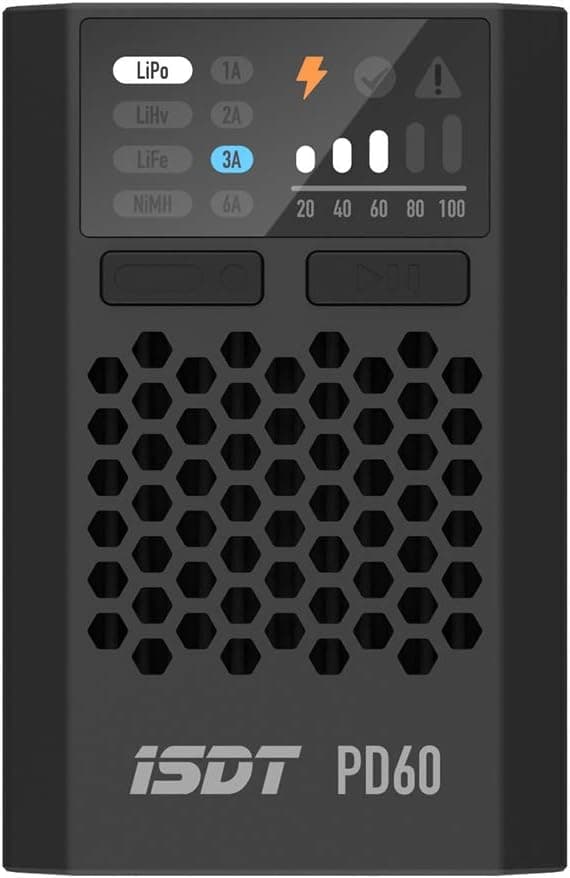
ISDT PD60S 60W 6A balance charger with XT60 and Type-C input for 1-4S LiPo batteries, a pocket field charger.
Price range: See on Amazon
What we liked
- + Type-C input charges from a USB-C power bank or laptop adapter
- + Tiny size fits in a pocket for field charging
- + ISDT build and display quality are well regarded
Trade-offs
- - 1-4S only, so 6S batteries need a different charger
- - 60W limit means slower charging for large packs
Who it is for
The PD60S targets FPV pilots and hobbyists who want a small charger they can carry in a backpack or pocket for topping up packs between flights at the field, rather than a bench charger meant to sit at home. Because it takes USB-C input instead of a bulky AC brick or bare DC leads, it pairs naturally with the USB-C power banks and laptop chargers many pilots already carry, which cuts down on extra gear needed for a day of flying. Anyone who mostly flies 1S to 4S packs and wants a compact, quick charging companion for their main charger is the core audience here.
Charging specs
The unit accepts DC input from 5V to 20V and charges at 1A, 2A, 3A, or 6A settings up to a maximum of 60W, with output through an XT60 connector and balancing through a JST-XH port at up to 0.5A per cell. It supports Quick Charge and USB Power Delivery protocols, so it can pull higher wattage from a compatible PD or QC power source rather than being limited to basic 5V USB output. Battery support covers 1 to 4S LiPo, LiFe, and LiHV packs, along with NiMH and NiCd packs up to 12 cells, giving reasonable flexibility for a charger this size.
Size and portability
At roughly 56 by 85 by 21 millimeters and about 87 grams, the PD60S is genuinely pocket sized compared with typical bench chargers, which is the entire point of this design. An aluminum heatsink with a honeycombed vent handles heat dissipation passively, without a fan, keeping the unit quiet during charging sessions at the field. This compact build does mean it is not meant to replace a full sized multi channel charger for anyone who needs to charge many packs quickly before a session, but it excels as a secondary or travel charger that rides along in the same bag as goggles and a radio.
Where it falls short
Because it tops out at 4S, pilots flying 6S batteries need a separate charger for those packs, so the PD60S cannot be a single universal solution for a mixed fleet spanning both voltage ranges. The 60W ceiling also means charging is noticeably slower than a 200W bench charger when working with larger capacity packs, so it works best as a top up tool between flights rather than the primary charger for a full day of racing or freestyle. USB-C PD or QC input is required to reach the higher current settings, so a basic USB-A charger or an older phone adapter will not deliver full charging speed and will leave the unit running well under its rated output.
Bottom line
For pilots who want a compact charger that lives in a flight bag and tops up 1 to 4S packs from a USB-C power bank or laptop charger, the PD60S is a practical field tool that avoids carrying a bulky AC charger to every session. It is not a replacement for a full sized bench charger for anyone with large batteries or 6S packs, and its charging speed is modest compared with higher wattage units. As a secondary charger built around convenience and small size, it fills a specific niche well.
Frequently asked questions
Can the ISDT PD60S charge 6S batteries?
No, it supports 1 to 4S LiPo, LiFe, and LiHV packs, so 6S batteries need a different charger.
What input does it need to reach full charging speed?
It needs a USB-C power source supporting Quick Charge or USB Power Delivery to reach its higher current settings and full 60W output.
How much does the charger weigh?
It weighs about 87 grams and measures roughly 56 by 85 by 21 millimeters, making it small enough to carry in a flight bag.
Does it have a cooling fan?
No, it relies on a passive aluminum heatsink with a honeycombed vent rather than a fan, which keeps it quiet during charging.
Prices change often, so check the current price and availability on Amazon.
Check price on AmazonDrone FPV Lab may earn a commission from the link above.