ISDT Q6 Nano LiPo Charger/Discharger DC 200W 8A Smart RC Battery Charger 2-6S Review (2026)
Updated September 20, 2026 · Research-based review
Our verdict
The ISDT Q6 Nano is a compact DC-only charger built for pilots who already carry a separate power supply or field battery. It delivers up to 200W and 8A across 2 to 6 cell packs in a pocket sized housing, making it easy to travel with, though it cannot power itself from a wall outlet alone.
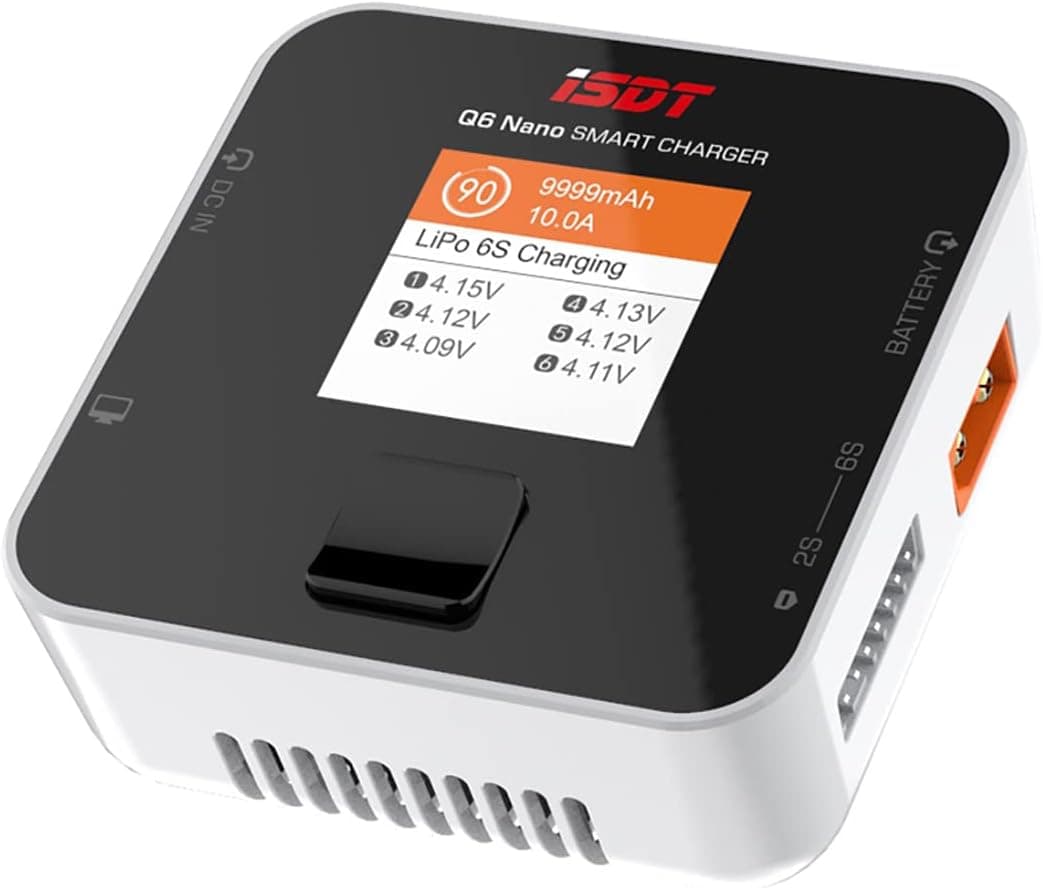
ISDT Q6 Nano DC LiPo charger and discharger with 200W and 8A output, a compact smart charger for 2-6S batteries.
Price range: See on Amazon
What we liked
- + Nano size makes it easy to carry in a field bag
- + 200W 8A output charges big packs quickly with a strong DC supply
- + 2-6S range handles most freestyle and long range batteries
Trade-offs
- - DC only, so you need a separate power supply or field battery
- - Does not charge 1S whoop packs directly, so micro pilots need another charger
Who this charger is for
The Q6 Nano suits FPV pilots who want a small, travel friendly charger to pair with a bench power supply at home or a field battery at the flying site, rather than an all in one unit with a built in AC adapter. Because it is DC only, it is a natural companion for pilots who already own a lab power supply or a separate high capacity field battery and just need a compact, capable charging brain to connect to it. Its 2 to 6 cell range makes it a good match for typical FPV freestyle, racing, and long range battery packs, though micro pilots flying 1S whoops will need a separate charger for those packs.
Charging power and battery support
According to the manufacturer and retailer listings, the Q6 Nano accepts DC input from 10 to 30 volts and delivers up to 200W of charging power at up to 8A, enough to charge large capacity packs or several batteries in parallel relatively quickly when paired with a sufficiently powerful DC source. It supports LiFe, Li-ion, LiPo, and LiHV chemistries at 1 to 6 cells, lead acid at up to 12 cells, and NiMH at up to 16 cells, and balance charges up to 0.5A per cell. A built in 5V 2A USB output port can also charge phones or other small devices from the same unit.
Size and interface
The listed dimensions are about 72 by 72 by 32 millimeters and roughly 119 grams, small enough to fit easily in a field bag alongside batteries and other gear, which is the main selling point over larger desktop chargers. It uses a 2.4 inch color IPS display for navigating charge settings, storage mode, and battery type selection, with upgradeable firmware for future feature additions. Reviewers note the interface is straightforward once you learn the button layout, and the compact size does not come at the cost of the display being hard to read in the field.
Trade-offs and how it compares
Against the ISDT 608AC, which bundles its own detachable AC power supply, the Q6 Nano is DC only and requires the pilot to already own or buy a separate power source, but in exchange it is smaller and often less expensive as a standalone unit. Compared with the ISDT PD60S, which tops out at a lower 60W and 6A but adds USB-C PD input for charging from a power bank, the Q6 Nano offers considerably more charging power for pilots who already have a beefy DC supply. Pilots without an existing power supply should budget for one separately, since the Q6 Nano alone cannot charge from a wall outlet.
Bottom line
The ISDT Q6 Nano is a strong pick for pilots who already have a DC power source and want a compact, high power charging brain to pair with it, whether at home or in the field. Its small size and 200W capability make it easy to justify as a travel charger, but buyers without a separate power supply need to factor that additional purchase into the total cost. For pilots who prioritize portability and charging speed over an all in one AC solution, the Q6 Nano is a well specified option.
Frequently asked questions
Does the Q6 Nano work with a wall outlet directly?
No, it is a DC-only charger, so it needs a separate DC power supply or field battery to connect to rather than plugging directly into AC power.
Can it charge 1S whoop batteries?
The charger is rated for 2 to 6 cell packs, so 1S batteries need a different charger.
How much does it weigh?
Listed weight is about 119 grams, making it easy to carry in a field bag.
What is the maximum output power?
Up to 200W and 8A when paired with a sufficiently powerful DC input source.
Prices change often, so check the current price and availability on Amazon.
Check price on AmazonDrone FPV Lab may earn a commission from the link above.