RadioMaster RP4TD ELRS Diversity FPV Receiver 2.4GHz ExpressLRS Nano RX with 65mm UFL T Antenna Review (2026)
Updated September 14, 2026 · Research-based review
Our verdict
A true-diversity 2.4GHz ExpressLRS nano receiver for pilots who want a more reliable link on freestyle and long range builds. The dual antenna, dual TCXO design costs a little space over single-antenna nanos, but the drop resistance is worth it for anyone tired of momentary glitches.
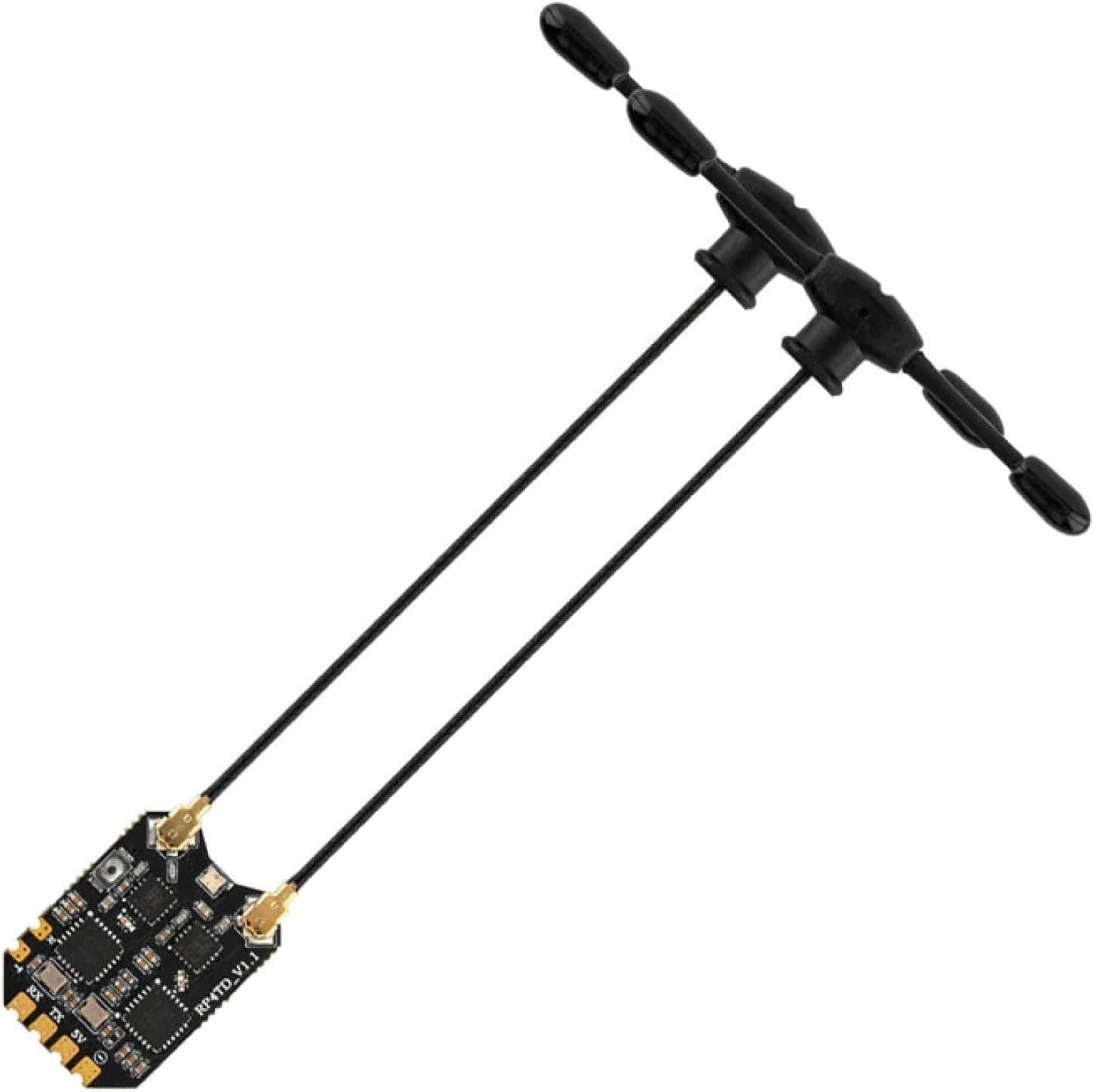
RadioMaster RP4TD ELRS diversity receiver on 2.4GHz with 65mm UFL T antennas, a nano RX for reliable FPV control.
Price range: See on Amazon
What we liked
- + True diversity reduces link drops during flips and long range flying
- + RadioMaster pairs cleanly with its own ELRS radios
- + 65mm T antennas are easy to mount on arms or standoffs
Trade-offs
- - Slightly larger than single-antenna nano receivers on tiny builds
- - Two antennas need careful routing to avoid prop strikes
Who this receiver is for
The RP4TD suits pilots building a 3 to 7 inch freestyle or long range quad who already fly ExpressLRS and want a link that shrugs off orientation changes during flips, dives, and rolls. Because it uses true diversity with two independent RF chains rather than a single antenna switching setup, it keeps tracking the strongest signal path even when the quad twists hard mid maneuver. Racers on tiny builds where every gram and millimeter counts may prefer a smaller single antenna nano receiver instead, since the RP4TD's second antenna and its routing needs a bit more room on the frame. Pilots who already run RadioMaster transmitters get the smoothest setup experience, since the receiver is designed to pair cleanly with RadioMaster's own ELRS radios and their companion app for binding and firmware updates.
What is inside the design
The receiver is built around an ESP32 microcontroller paired with two SX1281 RF chips, one for each of the two 65mm UFL T antennas, giving genuine diversity reception instead of a single radio switching between antennas. RadioMaster lists a maximum refresh rate up to 500Hz in normal mode or around 1000Hz in a faster packet mode, along with dual TCXO clock sources shared between the RF chips for stable timing on long flights. The board runs on 5V and weighs about 1.4 grams without the antennas attached, and measures roughly 24 by 16 by 4mm, small enough for most freestyle and long range frames. It communicates over the CRSF protocol through its UART pads, and firmware version 3.3.0 of ExpressLRS ships preinstalled, with built in WiFi so pilots can reconfigure or update it wirelessly through a browser based interface instead of soldering in a programmer.
Setting it up and flying with it
Binding follows the usual ExpressLRS process, and because the receiver has WiFi built in, updating firmware or adjusting settings can be done from a phone or laptop browser without removing the receiver from the frame. The two 65mm T antennas need separate mounting points, ideally on opposite sides or angles of the frame, so route them along arms or standoffs where they will not tangle with props or wiring during a hard crash. Builders moving from a single antenna nano receiver will notice the extra wire management step, but most freestyle frames have enough clearance on the frame arms or top plate to tuck both antennas away cleanly. Because the antennas are UFL connectors rather than soldered directly, a damaged antenna can be swapped without desoldering the whole receiver, which keeps repairs quick after a rough landing.
Trade-offs and how it compares
Against the BETAFPV SuperD, which uses dual SX1276 chips and a TCXO on the 915MHz band for extra long range penetration, the RP4TD sticks to 2.4GHz, so it fits pilots who want higher refresh rates for tighter control at typical park and field ranges rather than maximum distance. Compared with RadioMaster's own single antenna RP3 nano receiver, the RP4TD trades a slightly larger footprint and the extra antenna routing for the reliability gain of true diversity, which matters most on fast, aggressive flying where the quad's orientation constantly changes relative to the pilot. Riders who mostly fly gentle line style flights with a stable orientation toward the pilot may not need diversity at all and could save weight and space with a simpler nano receiver instead.
Verdict and who should look elsewhere
For freestyle and long range pilots already invested in ExpressLRS and RadioMaster radios, the RP4TD is an easy way to reduce dropped packets during aggressive flying, backed by a compact nano footprint, WiFi configuration, and swappable UFL antennas. Sub 3 inch whoop builders and anyone flying frames with very little arm space should look at single antenna nano receivers instead, since the second antenna and its mounting needs more room than tiny frames typically offer. Pilots who want maximum range over maximum reliability in tight maneuvers might also consider a 915MHz diversity receiver, which trades the RP4TD's higher refresh rate for better long distance signal penetration through obstacles.
Frequently asked questions
Does the RadioMaster RP4TD work with non-RadioMaster ExpressLRS transmitters?
Yes, since it runs standard ExpressLRS firmware it binds to any compatible 2.4GHz ELRS transmitter module, though RadioMaster's own radios and app give the smoothest setup experience.
Can I update the RP4TD firmware without a programmer?
Yes, the receiver has built in WiFi, so firmware updates and configuration changes can be done through a browser based WebUI from a phone or computer.
How much does the RP4TD weigh?
About 1.4 grams for the receiver board itself, not counting the two 65mm antennas.
Is this receiver true diversity or antenna switching?
It is true diversity, using two separate SX1281 RF chips and antennas that both actively receive at once rather than switching between a single chip and two antennas.
Prices change often, so check the current price and availability on Amazon.
Check price on AmazonDrone FPV Lab may earn a commission from the link above.