HGLRC RC2 Soldering Iron Kit 65W 24V Portable OLED Intelligent Temperature for FPV Racing Drone Review (2026)
Updated September 21, 2026 · Research-based review
Our verdict
A compact, fast-heating soldering pen built for FPV field repairs, with an OLED readout and smart temperature control packed into a lightweight pen body. It heats up quickly for battery pad work, though it depends on an external 24V power source that is not necessarily included.
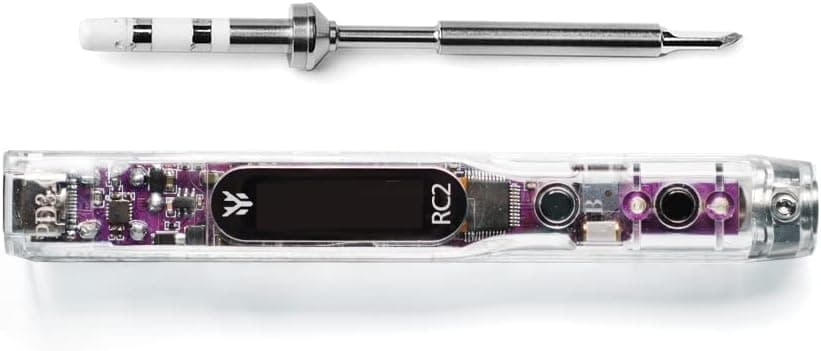
HGLRC RC2 soldering iron kit with 65W and 24V power, an OLED display and intelligent temperature for FPV builds.
Price range: See on Amazon
What we liked
- + 65W heats up fast enough for large battery pads
- + Portable design works well at the field for quick repairs
- + OLED display shows temperature clearly while working
Trade-offs
- - Needs a 24V power source, which may not be included
- - Portable irons have less thermal mass than bench stations
Power output and heat-up speed
The RC2 scales its power output with the voltage it is fed, reaching up to 65W when supplied 24V, with lower output around 40W at 19V and roughly 16W at 12V, so actual performance depends heavily on the power source used. At its top rating, HGLRC states the iron heats up in roughly 10 to 15 seconds, which is fast enough to tackle larger solder joints like battery pads or thick motor wires without a long warmup wait, a genuine advantage over slower basic irons when working at the field or bench under time pressure, especially when a repair needs to happen quickly between flights.
Display and temperature control
A 0.91-inch OLED display shows the working temperature clearly, with adjustable brightness and the ability to flip the screen orientation for left or right-handed use. Temperature is adjustable across roughly 50 to 450 degrees Celsius, and the iron uses an intelligent temperature control algorithm with temperature compensation and self-calibration, aimed at holding a steadier tip temperature under load than a basic fixed-wattage iron. Safety features include low voltage protection along with high temperature and high voltage alarms, which is a sensible inclusion for a compact tool that gets carried around and plugged into varying power sources.
Power source is the catch
The RC2 is a soldering pen rather than a self-contained station, meaning it needs an external power source to function: it supports USB-C PD3.0 and QC2.0 fast-charge protocols as well as a direct 12 to 25 volt DC input or a 3S to 6S lipo battery. Whether a suitable power source ships in this specific kit or needs to be sourced separately is worth confirming before buying, since reaching the full 65W and fastest heat-up time specifically requires a 24V-capable supply, and a basic USB-C charger may not deliver that top output. Pilots who already carry a PD-capable power bank or a spare lipo pack for field repairs will get the most out of this iron without buying anything extra.
Build and portability
The iron's shell is made from transparent, high temperature resistant, fireproof PC material, which keeps the body lightweight for field use while still tolerating the heat it generates near the tip end. It is designed to work with common TS and T12-style soldering tips, which keeps replacement tips easy to source rather than locking users into a proprietary tip system. That tip compatibility, combined with the compact pen form factor, makes it a reasonable fit for a field repair kit where space and weight both matter, and the clear housing makes it easy to spot the tip length at a glance when packing a bag in a hurry.
Who should buy the RC2
This iron suits FPV pilots and builders who want a portable soldering tool for field repairs, battery lead swaps, or general workbench use where fast heat-up and precise temperature readout matter more than the thermal mass of a full bench station. It is a good complement to a field repair kit already carrying a suitable battery or USB-C PD power bank. Anyone doing heavy, sustained soldering work, like batch-building many frames in a session, may still prefer a dedicated bench station with more thermal recovery capacity than a compact pen-style iron can offer.
Frequently asked questions
What is the maximum power output of the HGLRC RC2?
It reaches up to 65W when powered by a 24V source, with lower output around 40W at 19V and about 16W at 12V depending on the power supply used.
Does the RC2 include a power source?
The iron supports USB-C PD, QC fast charge, 12 to 25V DC, and 3S to 6S lipo batteries as power sources, so it is worth confirming what power source ships in this specific kit before buying.
What temperature range can the RC2 reach?
Temperature is adjustable from roughly 50 to 450 degrees Celsius, shown on the built-in OLED display.
What soldering tips work with the RC2?
It is designed to work with common TS and T12-style soldering tips, which keeps replacement tips easy to find.
Prices change often, so check the current price and availability on Amazon.
Check price on AmazonDrone FPV Lab may earn a commission from the link above.