RunCam Mini FPV DVR Video Audio Recorder 25x25mm M2 Lossless Video Output for VTX Review (2026)
Updated September 21, 2026 · Research-based review
Our verdict
This tiny onboard DVR suits micro and whoop builders who want a cleaner backup recording than goggle side DVR footage, without a full digital HD camera swap. Its 25mm M2 footprint fits tight stacks and it passes video through losslessly to the VTX, but recording quality tops out at standard analog VGA resolution.
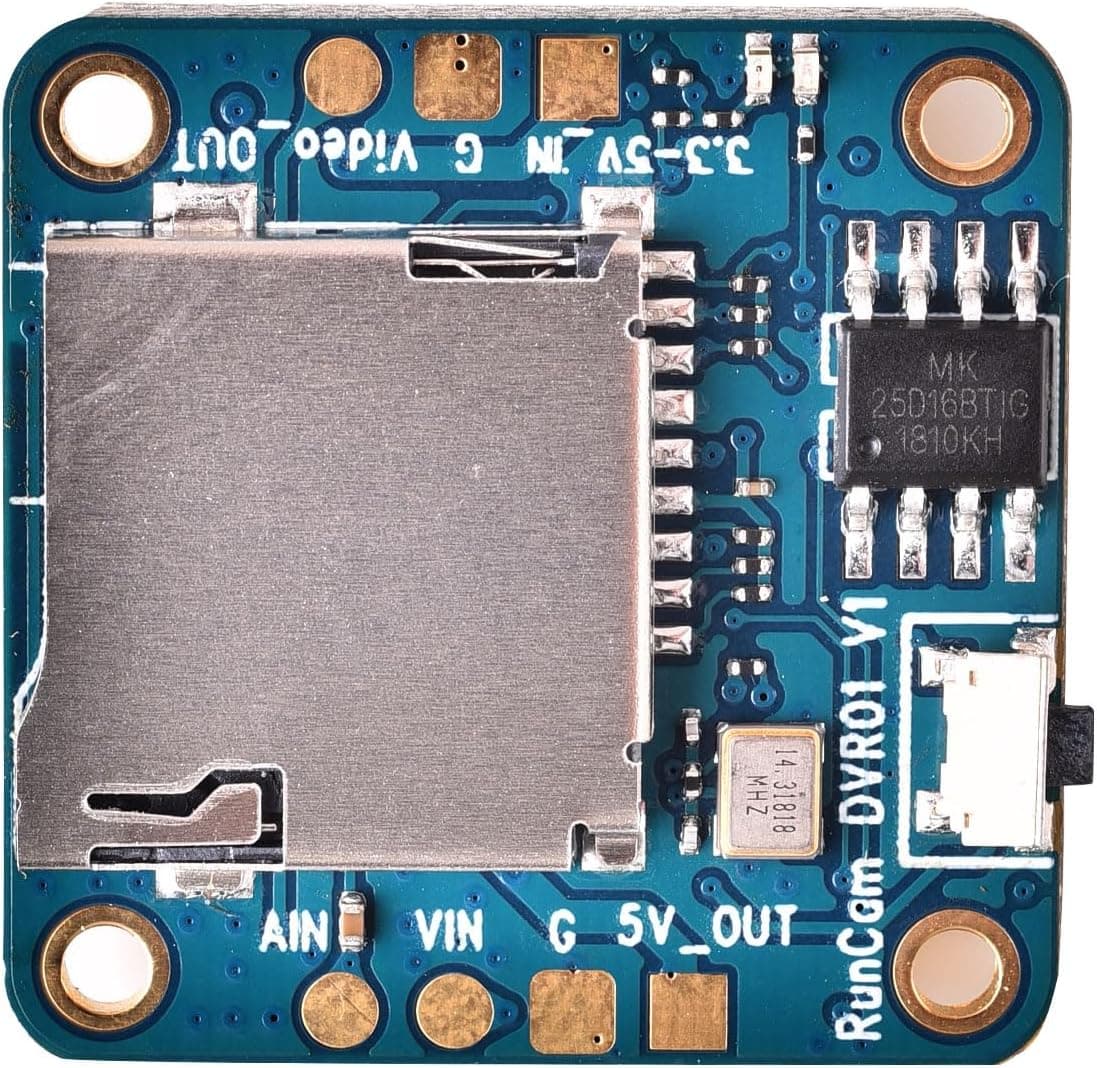
RunCam Mini FPV DVR in a 25x25mm board with M2 mounting, recording video and audio with lossless passthrough to the VTX.
Price range: See on Amazon
What we liked
- + Onboard recording captures a cleaner copy than goggle DVRs that record breakup
- + Lossless video output passes the camera feed on to the VTX untouched
- + 25x25mm M2 mounting fits whoop and micro stack patterns
Trade-offs
- - Onboard recording is still limited to analog camera quality
- - Adds wiring and a little weight to already tight micro builds
Size and mounting
The board measures 25 by 25mm with 20 by 20mm M2 mounting holes, matching the standard stack footprint used across most micro and mini FPV frames, so it drops into an existing build without needing a custom mount or adapter plate. Net weight comes in at about 3.5 grams, which is light enough that adding it to a stack does not meaningfully change the balance or thrust to weight ratio on typical 3 to 5 inch quads, and it is still a reasonable addition to smaller whoop class builds where every gram counts more. This M2 sizing is what makes it a practical add on rather than a dedicated build around component, since it slots between existing boards in a stack using hardware most builders already have on hand.
Video quality and format
Recording resolution is VGA at 640 by 480 pixels, running at 30 frames per second on NTSC or 25 frames per second on PAL, encoded in MJPEG and saved as AVI files to a Micro SD card. This is standard definition analog video quality rather than anything close to HD, which puts a hard ceiling on how much detail is recoverable from footage even though the recording itself is clean. The DVR passes the video signal through losslessly to the VTX, meaning the transmitted feed to the pilot's goggles is unaffected by the recorder being in line, so there is no signal quality trade off for adding the onboard recording capability to the video chain.
Storage and recording time
The unit supports Micro SD cards up to 32 gigabytes, and recordings save automatically in five minute segments rather than one continuous file, which limits data loss if power is cut mid flight since only the current segment would be affected. Based on the manufacturer's documentation, about one hour of recording consumes roughly 2 gigabytes of storage, meaning an 8 gigabyte card holds approximately three and a half hours of footage, which comfortably covers a full flying session before needing to swap or clear the card. Segmented recording is a sensible design choice for a component that lives on a crash prone aircraft, since a single large file is more vulnerable to corruption from a sudden power loss than a set of smaller ones.
Power and audio
Power input runs from 3.3 to 5.5 volts DC, working current up to 250 milliamps, and the unit can also pass 5 volts out at up to 250 milliamps to power a downstream component, which gives some flexibility depending on how the rest of the stack is wired. Audio recording is supported through a microphone input, and the DVR is capable of capturing the high frequency motor and prop noise typical of a racing or freestyle quad without needing an external microphone connected, since the onboard mic can pick up ambient sound directly. This combination of low power draw and flexible voltage input makes it straightforward to wire into most existing power distribution setups without a dedicated regulator.
Who should add this DVR
This is a good fit for micro and mini quad pilots who want a backup recording that captures a cleaner copy of the flight than what typically shows up in goggle side DVR footage, particularly during moments of signal interference where the transmitted feed breaks up but the onboard recording does not. Pilots expecting HD quality footage should look at a digital camera system instead, since this unit is built around standard definition analog capture rather than anything higher resolution. For builders who already run an analog camera and VTX and want a lightweight, low cost way to save footage locally without changing the rest of the video chain, this DVR is a reasonable addition to the stack.
Frequently asked questions
What resolution does the RunCam Mini DVR record at?
It records standard definition VGA video at 640 by 480 pixels, at 30 frames per second on NTSC or 25 frames per second on PAL.
How much SD card storage do I need?
It supports cards up to 32 gigabytes, and roughly 2 gigabytes covers about one hour of recording, so an 8 gigabyte card holds around three and a half hours of footage.
Does adding this DVR affect the video sent to my goggles?
No, the video output to the VTX is lossless, so the transmitted feed is unaffected by having the recorder in line.
Will it fit a standard micro quad stack?
Yes, it uses the common 25 by 25mm board size with 20 by 20mm M2 mounting holes found on most micro and mini FPV stacks.
Prices change often, so check the current price and availability on Amazon.
Check price on AmazonDrone FPV Lab may earn a commission from the link above.