HobbyFly XT60 XT30 RC Lipo Parallel Charging Board 2-in-1 Supports 5 Packs 2S-6S Review (2026)
Updated September 20, 2026 · Research-based review
Our verdict
This HobbyFly board suits pilots who want to charge up to 5 packs at once through an existing balance charger. Its main strength is the dual XT30 and XT60 output covering 2S to 6S packs, and its trade-off is that safe use depends on matching pack voltages and staying within the charger's current limit.
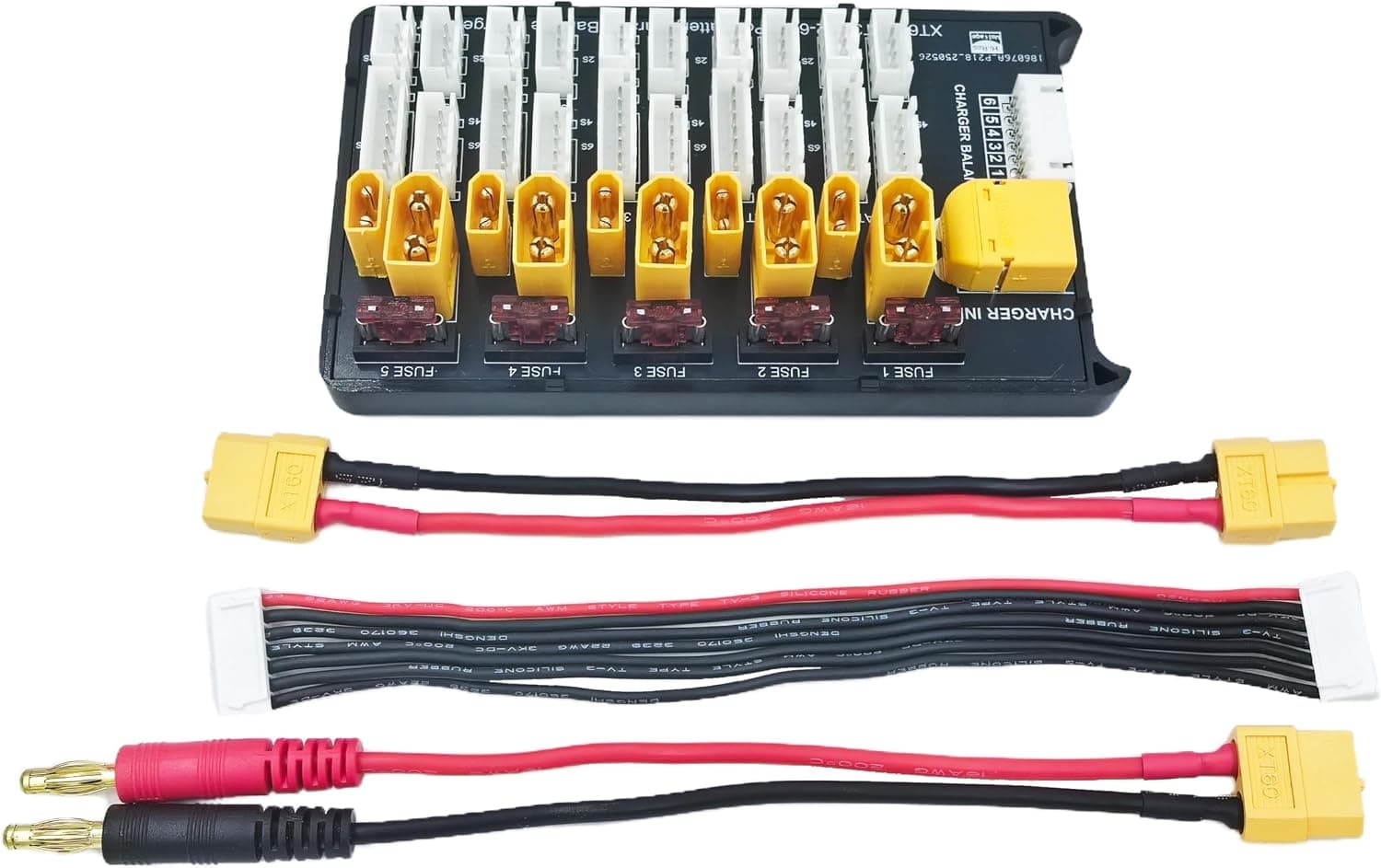
HobbyFly XT60 XT30 RC LiPo parallel charging board, 2-in-1 with support for 5 Packs from 2S-6S.
Price range: See on Amazon
What we liked
- + 2-in-1 XT60 and XT30 ports cover both freestyle and small quad batteries
- + Supports 5 Packs at once, speeding up charging before a session
- + 2S-6S range works with most FPV battery types
Trade-offs
- - Charger must handle the combined capacity safely
- - Mixing packs at different voltages can cause dangerous current flow
Who this board is for
Parallel charging boards like this one are aimed at pilots who own several small LiPo packs, such as those used on freestyle or micro quads, and want to top them all up in one sitting rather than charging each pack individually through a balance charger. Rather than being a charger itself, this board is a passive splitter that connects multiple same-voltage packs to a single charger output, so it suits anyone whose charging routine already involves plugging in one pack at a time and waiting. It is a poor fit for anyone charging large single packs individually, or pilots who are not comfortable double-checking pack voltage and cell count before connecting batteries in parallel, since mismatched packs on this kind of board are the main safety risk with parallel charging.
Connector options and capacity
The board provides both XT30 and XT60 connector options in one unit, letting pilots plug in a mix of small quad batteries that use XT30 plugs alongside larger packs that use XT60, without needing a separate board for each connector type. It supports up to 5 packs charging together, and the listing states support for 2S through 6S packs, which covers the voltage range used by most current freestyle and racing quads. The main charge lead uses a thicker gauge wire suited to carrying combined current from multiple packs, while the balance lead uses a lighter gauge appropriate for the lower current balance connections, a sensible design choice given the different current demands of each path.
Safety considerations for parallel charging
Parallel charging is a well-established practice in the hobby, but it depends entirely on every connected pack matching in cell count and being reasonably close in voltage before they are linked together, since connecting packs at different states of charge can cause a rapid, uncontrolled current flow between them. This board does not police that for the user, so safe use means checking each pack's voltage with a separate meter or checker before connecting it to the board, not simply plugging in whatever packs are on hand. Pilots also need to make sure their charger's maximum output current comfortably covers the combined capacity of every pack connected at once, since exceeding a charger's rated output can lead to overheating or an inaccurate, incomplete charge across the packs.
Practical charging routine
In everyday use, a board like this saves real time for pilots who fly multiple packs in a single session, since it turns what would be five separate charge cycles into one combined session running at whatever rate the connected charger supports. That time savings is most valuable for pilots heading to the field with a full battery bag who want everything ready the night before, rather than babysitting a charger through pack after pack. It is less useful for pilots who only own one or two packs, since the benefit of parallel charging scales with how many same-voltage batteries someone regularly cycles through in a normal flying session.
Overall value
As a simple, connector-focused accessory rather than an electronic device with its own safety logic, this board is inexpensive relative to buying a multi-channel standalone charger, and it lets pilots keep using a charger they already own while gaining the convenience of charging several packs together. The value proposition is strongest for pilots who already practice safe parallel charging habits and simply want a board with connector flexibility for both XT30 and XT60 packs. Anyone new to parallel charging should learn the safety fundamentals first, since the board itself provides convenience and connector coverage but no protection against connecting mismatched or damaged packs together.
Frequently asked questions
Can I charge 2S and 4S packs together on this board?
No, packs connected in parallel need to match in cell count and be close in voltage. Mixing different pack voltages on the same board is unsafe.
Does this board work as a standalone charger?
No, it is a passive splitter that connects multiple packs to an existing balance charger rather than charging on its own.
What connectors does this board support?
It includes both XT30 and XT60 outputs, covering small quad packs and larger packs on the same board.
How many packs can I charge at once?
The board supports up to 5 packs charging together, provided the charger's output current covers the combined load.
Prices change often, so check the current price and availability on Amazon.
Check price on AmazonDrone FPV Lab may earn a commission from the link above.